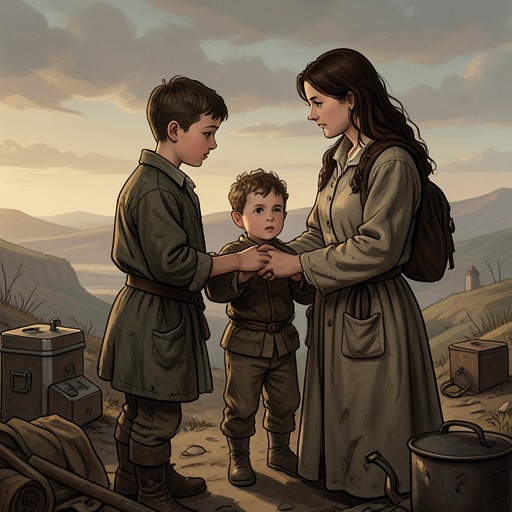
Molly Johnson—Danny Johnson Mother-Son Relationship
The Drover's WifeMolly Johnson and Danny Johnson share a mother-son relationship shaped by affection, hardship, and the gradual transfer of responsibility from parent to child. Molly regards Danny as her special, beloved eldest son, yet she also depends on his help as poverty and danger narrow the choices available to their family. Their bond therefore joins intimate tenderness to practical preparation: she wants to keep him near, but knows that he is growing toward adult work and may have to help sustain the household.
Identity and Early Bond
Danny is at an in-between age, nearly twelve when Molly reflects on his impending adulthood. He is still her little boy, but the prospect of droving for work as early as the following year already presses on her. Molly hopes to have him at home for several more years; at the same time, the family’s finances make his future contribution difficult to dismiss. Her uncertainty is not a lack of confidence in him, but a mother’s reluctance to see childhood give way to necessity.
The material details of their life give that tension a concrete form. On the family’s Sunday walks, Danny is barefoot, while his brothers’ worn boots still fit; Molly expects him to receive his father’s old boots in winter. She wishes instead that she could buy him a new pair, because she believes he deserves better and has already seen too much. The boots mark both the family’s scarcity and the approaching transition she would rather postpone.
Molly’s tenderness toward Danny is especially explicit when she notices his concern for her. After he takes her hand and asks whether she is all right because she has been frowning, she reassures him with a gentle pat. She thinks of him as her angel and soulmate. Her response is characteristic of their closeness: Danny notices what she tries to conceal, and she answers his concern with affection even while trying to shield him from the burdens behind it.
Care, Trust, and Shared Responsibilities
Molly’s care is not limited to reassurance. She teaches her children through the stories and conversations that accompany their long walks, telling them about her own childhood and what she learned from her father. She is more open with them outdoors than she would be at home, where she might shut down the same questions. Danny participates in this exchange as a capable storyteller, but the walks also let him learn family history from Molly and keep alive the practice of sharing stories that she inherited from her father.
The river episode shows Molly’s protective instincts under immediate threat. During a sudden flood, she sees Danny clinging to a boulder, with Delphi’s rag doll in his mouth, while the rising water and a moving boulder put him in danger. She calls for him to hold on and plunges into the current to reach him. The scene makes her attachment an action rather than an abstract sentiment: when Danny’s safety is at stake, she risks herself to try to get to him. His rescue comes through the flood’s shifting debris, not through her successful intervention, but her response reveals the depth and urgency of her maternal commitment.
That commitment also coexists with trust in Danny’s growing competence. When the children are sent away in the covered wagon, Molly gives him a list and specific instructions: he is to ensure his siblings behave, exchange meat for fresh vegetables and other supplies, and return home promptly because she will need help. She tells him that bullets are low, bringing the practical dangers of their household into the responsibilities she places in his care. Danny is frightened at the prospect of his first delivery, but he accepts the task. Molly’s instructions make him accountable for his younger siblings and for a supply errand, while her insistence that he come straight back confirms how much she still needs his presence.
The coming birth adds a more personal responsibility. Molly tells Danny that her age may make the birth difficult and that she needs him with her. She recalls that, when Delphi was born, he had already taken his younger brothers to stay with the McGuinnesses and brought them safely home the following week. His earlier competence gives her reason to rely on him, even as the prospect of witnessing his mother’s delivery frightens him. Their relationship shifts here without losing its tenderness: Molly remains his mother and protector, but she also asks him to stand beside her in a moment when she may need his help.
Danger, Separation, and Racialized Threat
The family’s hardships make their closeness vulnerable to forces beyond either mother or son. When Molly asks an Aboriginal man to leave because his presence may bring troopers to her doorstep, she is weighing the danger to herself and her family against the possibility of attracting official attention. Her concern is sharpened by the authority’s delayed response: Nate Clintoff learns that Molly may not be checked on for two days, and that the officials would then regard their responsibility for her welfare as finished. In this environment, the family cannot count on timely protection from those who hold power.
The threat becomes explicit when Miss Shirley calls Molly’s children “Octaroon” and appeals for their removal. Judge Eisenmangher signs an authorization for their removal, treating racial classification as grounds to separate them from their mother. Danny hears the label and asks Molly what it means. His question brings the bureaucratic threat into their relationship as a direct family crisis: he is not merely exposed to an official decision, but turns to his mother to understand what may happen to them.
Molly recognizes the word from her own childhood. She remembers Miss Shirley discussing the possibility of sending her away because of her mixed heritage, and understands that the same logic now threatens her children. When she later confronts Miss Shirley and Father McGuinness, she takes the removal paper and burns it; its language includes the claim that removal is necessary and that permission has been granted. Destroying the document cannot undo the system that produced it, but it is a decisive refusal to let its authority go uncontested. For Danny, the episode exposes the connection between his mother’s past and the danger now directed at their family.
Separation, Loss, and Enduring Care
The legal case against Molly makes Danny’s absence consequential. Nate reflects that Danny is the only witness to Molly’s truth, but he cannot be found. The Crown’s closing argument depicts Molly’s resistance as the product of inherited hatred, her knowledge of her heritage, and Yadaka’s influence. The account frames her through racialized suspicion rather than the circumstances of abuse and injustice that shape her life. With Danny unavailable to speak, the family’s intimate knowledge of Molly cannot readily enter the courtroom as evidence.
Even in custody, Molly’s attention remains fixed on her children. She tells Nate that they will have all the help and love they need, expressing hope for their future while she faces the consequences of her case. That hope echoes the care shown in smaller scenes: the planned new boots, the supply list, the request that Danny return home, and her attempt to reach him in the flood. Across these circumstances, her love is both emotional and practical, directed toward keeping the children safe and equipped for a world that repeatedly threatens them.
Narrative Significance
The relationship illuminates how maternal protection changes under pressure. Molly wants Danny to remain a child at home, but material hardship draws him toward work and makes her rely on him for errands, sibling care, and support during childbirth. His growing responsibility does not replace their bond; it develops within it. Her affection gives his duties a familial purpose, while his attentiveness and readiness to help make him an increasingly important participant in the household’s survival.
Their bond also gives the threat of child removal its human scale. The judge’s authorization and the racial category used to justify it are not abstractions to Danny: he asks his mother what the word means, and she understands that the label may take her children from her. In contrast to official claims about protection, the scenes of their shared life show Molly educating, feeding, guiding, and relying on her children, while Danny looks to her for reassurance and explanation. The relationship thus holds together the novel’s account of family care and the forces that would classify, separate, and silence it.